spacing-56
0
NON-PIVOTAL STUDY DATA
h2
size-h6
red
regular
left
18px | 24px
Additional analysis
h2
size-h6
red
regular
left
16px | 24px
REXULTI® (brexpiprazole) + antidepressant separated from antidepressant + placebo as early as Week 1 and continued to Week 61
h2
size-h6
text-heading-sage-light
regular
left
23px | 32px
18px | 24px
851px
spacing-16
spacing-8
The weekly time points prior to Week 6 were not powered for statistical comparison and are descriptive only. Primary endpoint was the mean change from baseline to Week 6 in the MADRS total score in the randomization phase.1
text-body
font-whitney
weight-whitney-default
size-medium
| 19.2px
| 21px
915px
spacing-16
spacing-16
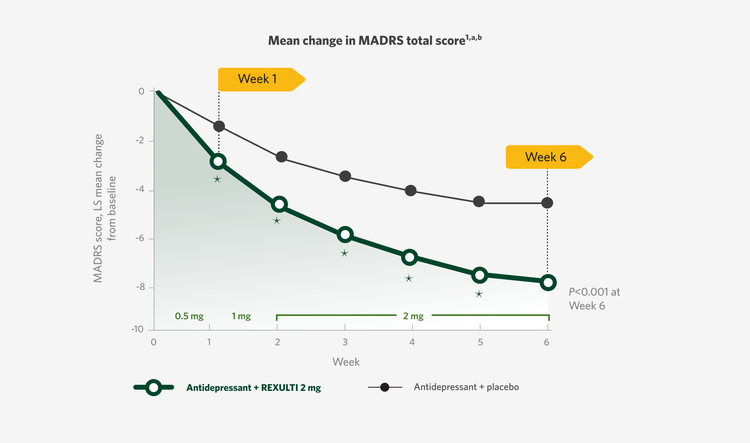
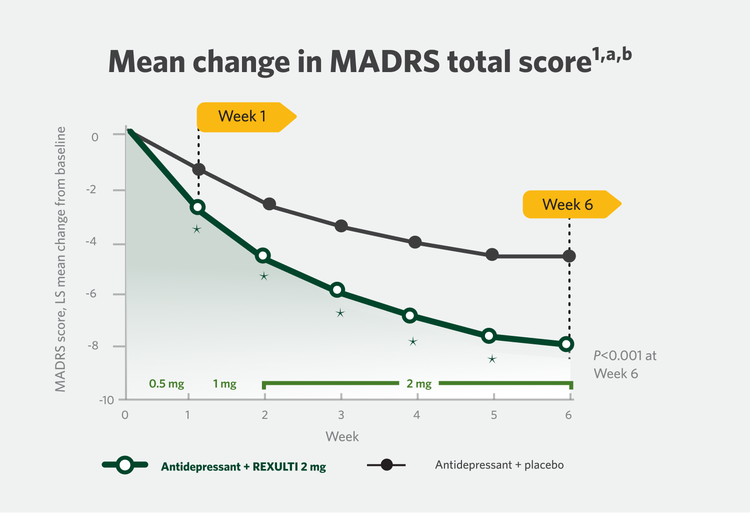
Mean changes in MADRS total score
left
px
920
edge-to-edge-mob
spacing-16
spacing-16
aBaseline mean MADRS scores were 27.3 for ADT + placebo (n=178) and 26.9 for ADT + REXULTI (n=175).
bP values are based on mixed model repeated-measures analysis.
*P=nominal.
bP values are based on mixed model repeated-measures analysis.
*P=nominal.
text-left
text-body
font-whitney
weight-whitney-default
size-footnote
| 15px
10px | 13px
spacing-36
spacing-4
38
spacing-30
9
NON-PIVOTAL STUDY DATA
h2
size-h6
red
regular
left
16px | 24px
Post hoc analysis
h2
size-h6
red
regular
left
16px | 24px
REXULTI® (brexpiprazole) + antidepressant change in MADRS total score in adult patients with MDD—with or without symptoms of anxiety
h2
size-h6
text-heading-sage-light
regular
left
23px | 32px
16px | 24px
851px
spacing-16
spacing-24
Using pooled data from 3 similarly designed 6-week randomized studies, including both 2 mg and 3 mg doses, changes were evaluated in MADRS total score in patients with MDD—with and without symptoms of anxiety.1-3,c,d
text-body
font-whitney
weight-whitney-default
size-medium
| 19.2px
16px | 19.2px
900px
container-left
spacing-16
spacing-16
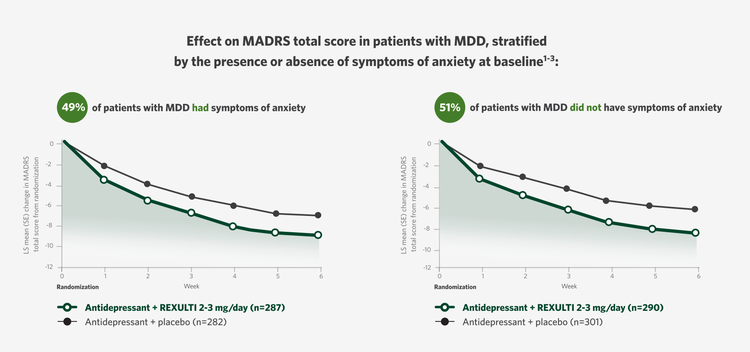
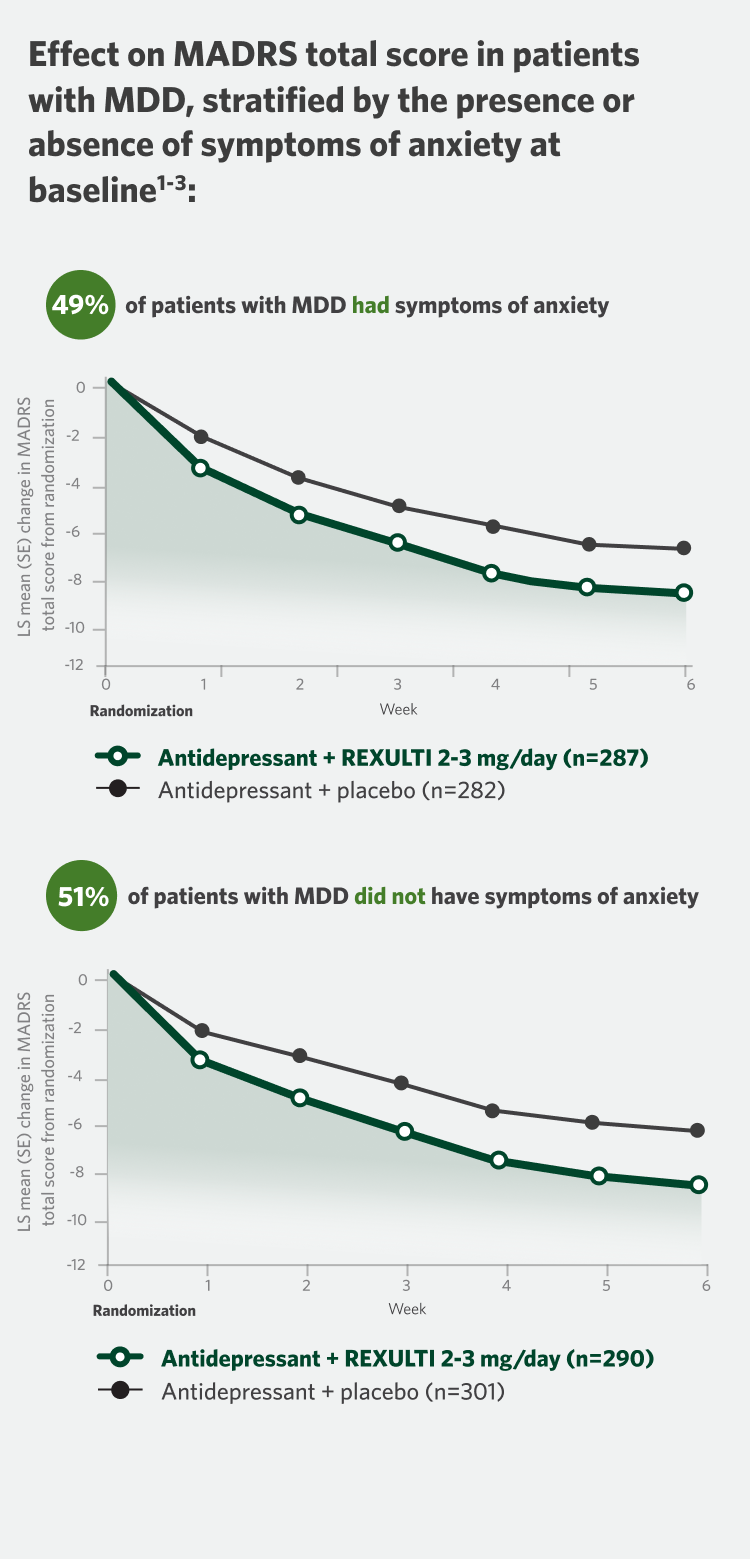
Effect on MADRS total score in patients with MDD, stratified by the presence or absence of symptoms of anxiety at baseline
left
px
920
edge-to-edge-mob
spacing-16
spacing-32
7
Study limitations: These analyses did not assess the effect of treatment on symptoms of anxiety. Patients with anxiety symptoms had a higher MADRS total score at baseline and the effects of anxiety and illness severity on outcomes were not differentiated. Statistical adjustments were not made for multiple comparisons, potentially inflating the type 1 error rate.3
text-left
text-body
font-whitney
weight-whitney-default
size-medium
| 19.2px
900px
spacing-36
spacing-16
29
Adding REXULTI reduced mean MADRS total score by over 2 points in patients with MDD with or without symptoms of anxiety3:
text-left
text-body
font-whitney
weight-whitney-default
size-medium
16px | 19.2px
15px | 21px
920px
spacing-6
spacing-16
- For patients with symptoms of anxiety, the LS mean change at Week 6 between ADT + REXULTI 2-3 mg/day and ADT + placebo was -2.19 (95% CI: -3.60 to -0.78)
- For patients without symptoms of anxiety, the LS mean change at Week 6 between ADT + REXULTI 2-3 mg/day and ADT + placebo was -2.34 (95% CI: -3.58 to -1.10)
text-left
text-body
font-whitney
weight-whitney-default
size-medium
16px | 19.2px
850px | 323px
bullet-marigold-triangle
spacing-40
spacing-16
cBaseline demographics and clinical characteristics were similar between treatment subgroups; however, patients with symptoms of anxiety were more likely to be female and have a higher MADRS total score at baseline compared with patients without symptoms of anxiety.3
text-left
text-body
font-whitney
weight-whitney-default
size-footnote
10px | 13px
920px
bullet-marigold-triangle
spacing-8
spacing-4
dOf the patients that received an ADT plus REXULTI 2 mg, 3 mg, or placebo, 49% had symptoms of anxiety, defined as a score of ≥7 at baseline on the HAM-D anxiety/
somatization factor.3
text-left
text-body
font-whitney
weight-whitney-default
size-footnote
10px | 13px
890px
bullet-marigold-triangle
spacing-8
ADT, antidepressant treatment; HAM-D, Hamilton Rating Scale for Depression; LS, least squares; MADRS, Montgomery-Åsberg Depression Rating Scale; MDD, major depressive disorder; SE, standard error.
text-left
text-body
font-whitney
weight-whitney-default
size-footnote
| 16.8px
10px | 13px
930px
bullet-marigold-triangle
spacing-24
spacing-44
45
spacing-56
57
57
Continue exploring REXULTI
h2
size-h5
text-heading-emerald
whitney-black
center
20px | 24px
heading-with-inline-line
spacing-56
45
spacing-0
spacing-18
spacing-88
Please see FULL PRESCRIBING INFORMATION,
including BOXED WARNING.
including BOXED WARNING.
spacing-32
References: 1. Thase ME, Youakin JM, Skuban A, et al. Efficacy and safety of adjunctive brexpiprazole 2 mg in major depressive disorder: a phase 3, randomized, placebo-controlled study in patients with inadequate response to antidepressants. J Clin Psychiatry. 2015;76(9):1224-1231. 2. Thase ME, Youakim JM, Skuban A, et al. Adjunctive brexpiprazole 1 and 3 mg for patients with major depressive disorder following inadequate response to antidepressants: a phase 3, randomized, double-blind study. J Clin Psychiatry. 2015;76(9):1232-1240. 3. Thase ME, Weiller E, Zhang P, Weiss C, McIntyre RS. Adjunctive brexpiprazole in patients with major depressive disorder and anxiety symptoms: post hoc analyses of three placebo-controlled studies. Neuropsychiatr Dis Treat. 2019;15:37-45.
text-body
font-whitney
weight-whitney-default
size-footnote
| 16.8px
11px | 15.8px
939px
container-left
hide-on-mobile reference-text
spacing-88
104
71