Demonstrated efficacy across both short-term and maintenance studies with REXULTI® (brexpiprazole)
Short-term efficacy data: 20-point reduction in PANSS total score from baseline with REXULTI 4 mg across 2 trials in adults
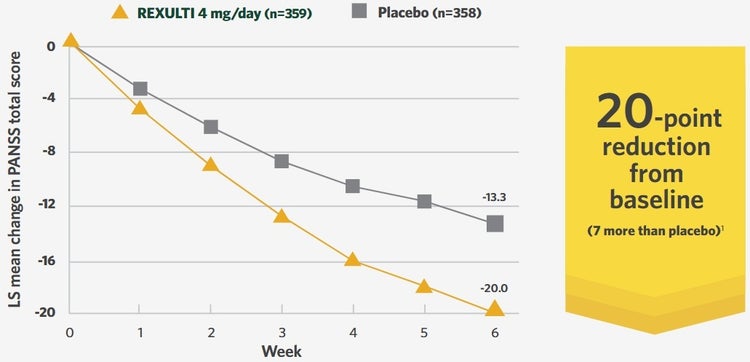
- Two 6-week, randomized, placebo-controlled, fixed-dose pivotal trials conducted in patients who met DSM-IV-TR criteria for SZ and would benefit from hospitalization or continued hospitalization for an acute exacerbation of symptoms2
- Treatment initiated at 1 mg/day on Days 1-4, titrated to 2 mg/day on Days 5-7, then maintained or increased to 4 mg/day on Day 8, depending on treatment arm
Difference in mean reduction in PANSS total score vs placebo at Week 6 in both pivotal trials

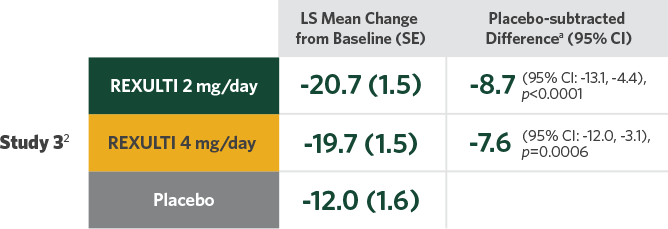
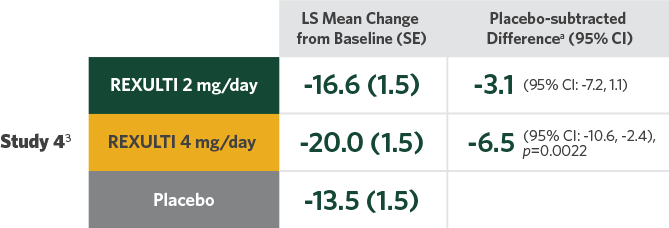
- Statistical significance was achieved at 2 mg/day vs placebo in Study 32
- A 1-mg/day treatment arm was included in Study 4. Statistical significance was not achieved for the primary endpoint with either the 1-mg/day dose or the 2-mg/day dose compared with placebo3
aDifference (drug minus placebo) in least-squares mean change from baseline.
CI, confidence interval; DSM-IV-TR, Diagnostic and Statistical Manual of Mental Disorders, Fourth Edition (Text Revision); LS, least squares; PANSS, Positive and Negative Syndrome Scale; SE, standard error; SZ, schizophrenia.
REXULTI 4 mg significantly decreased PANSS total score for patients who were markedly to moderately ill vs placebo across 2 trials in adults4,5
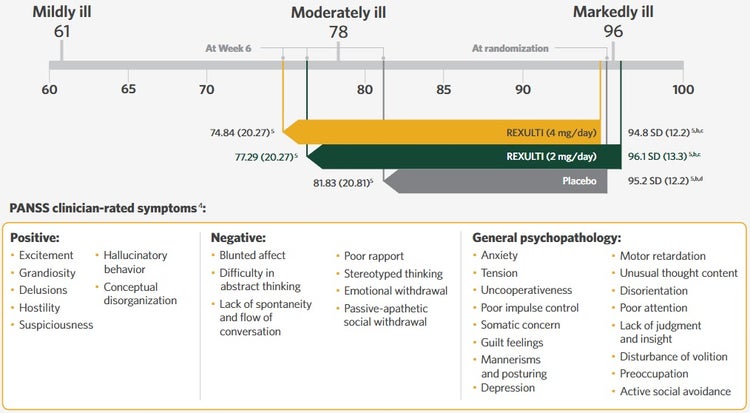
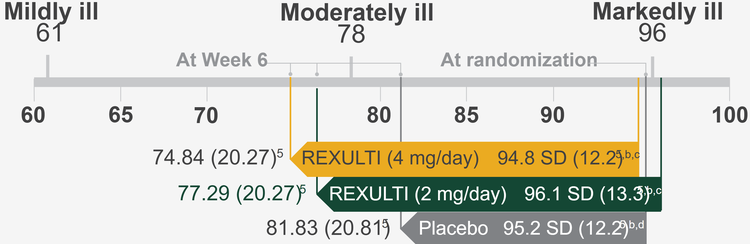
aPatients were hospitalized for screening and throughout the 6-week treatment phase.3
bMean baseline PANSS total scores (SD) for patients were Study 3: REXULTI 2 mg/day, 95.9 (13.8); REXULTI 4 mg/day, 94.7 (12.1); placebo, 95.7 (11.5); Study 4: REXULTI 2 mg/day, 96.3 (12.9); REXULTI 4 mg/day, 95.0 (12.4); placebo, 94.6 (12.8).3
cn=718; sum of patients in the efficacy analyses who received REXULTI 2 mg/day (n=359) or 4 mg/day (n=359) in Study 3 and Study 4.
dn=358; sum of patients in the efficacy analyses who received placebo in Study 3 and Study 4.
SD, standard deviation.
Study 6:
Demonstrated efficacy as maintenance treatment in adults
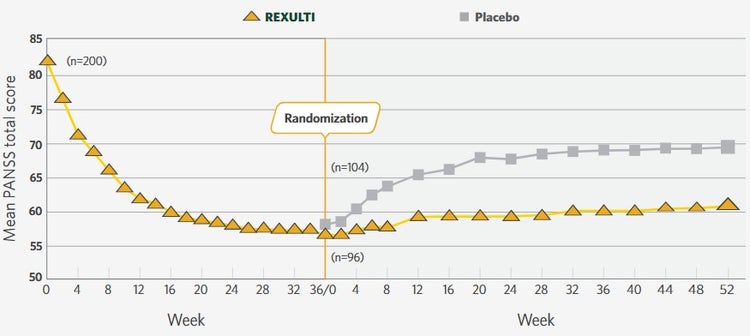
Mean baseline PANSS total scores [SD] (at Week 0 in the maintenance phase): REXULTI (n=97), 56.5 [8.7]; placebo (n=105), 58.1 [8.1].6
Patients had a PANSS total score of >80 and, if needed, were part of a 1- to 4-week washout phase of previous medications before moving on to stabilization.6
Study 6 trial design7
Study 6 trial design7
Single-blind stabilizationa
Patients with SZ were stabilized on flexible doses of REXULTI 1 mg/day to 4 mg/day for at least 12 consecutive weeks
Double-blind maintenance
Patients who met stabilizationa criteria and remained on a stable dose of REXULTI for at least the last 4 weeks were then randomized 1:1 for 52 weeks to either:
- Their achieved stable dose of REXULTI
or - Placebo
Stabilization was defined as all of the following: (1) outpatient status; (2) PANSS total score ≤70; (3) a PANSS score of ≤4 on conceptual disorganization, suspiciousness, hallucinatory behavior, and unusual thought content; (4) CGI-severity ≤4; (5) no current suicidal behavior; (6) no violent or aggressive behavior resulting in injury or property damage.6
CGI, Clinical Global Impression.
Important Warning and Precaution for Cerebrovascular Adverse Events, Including Stroke
-
Mean dose during maintenance phase was 3.6 mg/day6
-
Primary endpoint—time from randomization to impending relapse in the maintenance phase
-
Impending relapse was defined as any of the following:
- CGI-Improvement score of ≥5 and an increase to >4 on PANSS conceptual disorganization, hallucinatory behavior, suspiciousness, or unusual thought content, with either a ≥2 increase on a specific item or ≥4 increase on the combined 4 items
- Hospitalization due to worsening of psychotic symptoms
- Current suicidal behavior
- Violent/aggressive behavior
-
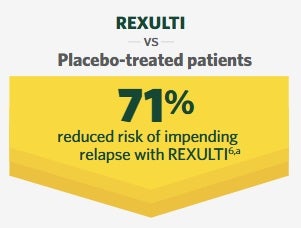
- The risk of impending relapse was calculated using a Kaplan-Meier estimation over the 52 weeks. The calculated hazard ratio (HR=0.292 [95% CI: 0.156, 0.548], p<0.0001) was used to estimate the reduction in risk of impending relapse for patients continuing treatment with REXULTI vs those given placebo6
- Trial was terminated early because maintenance of efficacy had been demonstrated
Of the 202 patients randomized, 2 patients were excluded from the efficacy analysis: 1 patient taking REXULTI did not have post-randomization efficacy evaluations, and 1 patient taking placebo did not take the investigational medicinal product.
HR, hazard ratio.